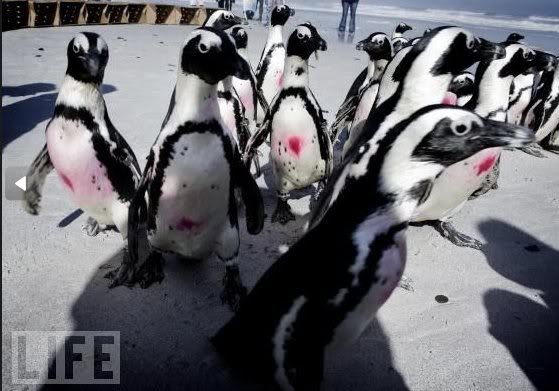
Penguins walk toward the ocean after being released near Cape Town, South Africa. The 38 birds had been treated for oil pollution they'd suffered in Namibia.
Photo: GIANLUIGI GUERCIA/AFP/Getty Images
May 26, 2009
Showing posts with label ecology. Show all posts
Showing posts with label ecology. Show all posts
Thursday, June 11, 2009
I'm getting closer to my home


Thursday, December 4, 2008
3/4 of Big Antarctic Penguin Colonies to Disappear?
Up to 75 percent of major Antarctic penguin colonies may disappear if climate change continues to heat up the continent, according to a recent report.
A global temperature increase of 3.6 Fahrenheit (2 degrees Celsius) above pre-industrial levels will result in widespread changes to sea ice that the birds depend on for survival.
The temperature increase will, in any scenario, lead to a major reshuffling of colonies of emperor and Adélie penguins—the two penguin species that rely on ice for hunting and breeding.
In addition, there could be marked habitat loss of these iconic birds, said the report commissioned by the conservation group WWF.
The penguins' range is already shrinking, said David Ainley, a penguin expert with H.T. Harvey & Associates of San Jose, California, who co-authored the report.
Up to 50 percent of emperor colonies and 75 percent of Adélie colonies could be affected, the researchers said.
Source: National Geographic
Monday, November 24, 2008
Puppy power saves penguins

After dwindling to a dire population of just four in 2005, penguin numbers at Middle Island have rebounded this year.
An early start to the breeding season has already seen eight penguin chicks leave the nest and another 16 are still on the island in various stages of development.
Deakin University PhD student Amanda Peucker, who is monitoring the penguins' progress, said the population growth could largely be attributed to the success of the guard dogs in keeping predators, like foxes, off the island.
"A couple of years ago we had something like 180 penguins killed by foxes, now there aren't even any fox prints in the area," she said.
Source: The Age
Tuesday, March 4, 2008
Ice Penguins

(via)
Tuesday, February 12, 2008
Penguin Science

David Ainley has been studying the Adelie penguin colony at Cape Royds for 12 years, spending much of the southern hemisphere summer in a tent. But Ainley has made it possible for millions of people to look in on the penguin colony here by a live camera feed to his web site www.penguinscience.com
Tuesday, December 11, 2007
Penguins at risk from melting ice
Melting ice caps in Antarctica are leaving penguins in serious trouble.
Experts say global warming is happening five times faster at the penguins' home than anywhere else on the planet.
The melting ice is destroying nesting sites and four species are said to be under threat - including the largest penguin in the world, the Emperor.

Sunday, October 7, 2007
Yellow-eyed Penguin Trust

This unique penguin is found only along New Zealands south islands' eastern coastline, as far north as Banks Peninsula and as far south as Stewart Island and beyond to Campbell Island.
In the 1980s research on the Otago Peninsula showed that the penguin population had declined severely, and that the yellow-eyed penguin was now considered to be an endangered species. This was due to severe predation and loss of habitat.
In 1987 Dunedin conservationists formed the Yellow-eyed Penguin Trust with the aim of saving the penguin by restoring coastal forest and controlling predators. The penguin is the focus but the Trust's efforts also benefit other native species of plant and animal.
The Trust is based in Dunedin but manages land and penguin interests in the whole of mainland New Zealand.
The Trust's first twenty years have seen the penguin population increase, yet they are still a long way from being a self-sustaining population.
Monday, July 16, 2007
10 Penguin Species Could Gain Endangered Species Protection
The U.S. government has announced it is advancing the emperor penguin and nine other penguin species toward protection under the federal Endangered Species Act. The action comes in response to a formal administrative petition filed by the Center for Biological Diversity in November 2006 seeking protection for the species, as well as a June 2007 Notice of Intent to Sue the agency for failing to respond to the petition. The primary threats to penguins are global warming and industrial fisheries.
Abnormally warm ocean temperatures and diminished sea ice have wreaked havoc on penguin food availability in recent decades. Less food has led to population declines in species ranging from the southern rockhopper and Humboldt penguins of the islands off South America, and the African penguin in southern Africa, to the emperor penguin in Antarctica. The ocean conditions causing these declines have been linked by scientists to global warming and are projected to intensify in the coming decades.
Thursday, April 5, 2007
Want to monitor climate change? P-p-p-pick up a penguin!

“If penguins are travelling further or diving deeper for food, that tells us something about the availability of particular fish in regions of the Antarctic. We may be able to assess the pressure exerted by king penguins on this ecosystem, and look at the effects of both climate change and overfishing in this region of the world”, says Dr Lewis Halsey who will present his results on Wednesday 4th April at the Society for Experimental Biology’s Annual Meeting in Glasgow.
Tuesday, February 20, 2007
Antarctic Peninsula warming affects penguins, krill

"We're already seeing the marine ecosystems respond dramatically to increases in temperatures along the Antarctic Peninsula," said Berry Lyons, professor in the School of Earth Sciences and director of the Byrd Polar Research Center at Ohio State University. "Researchers are seeing the movement of penguin populations southward down the peninsula as sea ice lessens along its margins," Lyons said. "Gentoo and chinstrap penguins are shifting south into areas now populated by adelie penguins, and the adelies are being forced further south, all because of the change in sea ice."
Subscribe to:
Posts (Atom)