Showing posts with label nature. Show all posts
Showing posts with label nature. Show all posts
Monday, February 16, 2009


Thursday, January 22, 2009
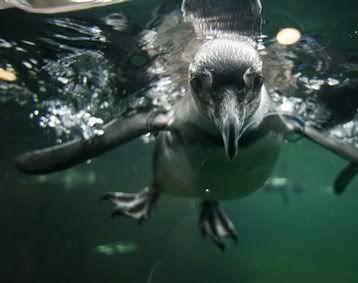
Underwater
AFP/Getty Images
Tuesday, September 23, 2008
Penguins begin their arrival to Argentine coasts
Thousands of Magellanic penguins have begun their yearly arrival to the coasts of the southeastern Argentine province of Chubut, where they will mate and breed for the next few months.
Local media on Friday broadcasted live images of the penguins walking ashore to meet their mates in what they call "The Penguin's Vigil".
And for the first time, this year the local Chubut government have also set up a website which is streaming the penguins' arrival to the Patagonia for 72 consecutive hours.
The migratory sea birds travel thousands of miles every year around this time from the coasts of Brazil to meet their partners and reproduce in the Patagonia's penguin colonies.
As temperatures begin to drop the penguins will then make their way back up the continent in search of warmer waters.
Chubut penguin website (in English)
Chubut daily penguin videos
Thursday, July 31, 2008
Penguins wash up closer to equator in Brazil

Biologists believe stronger-than-usual ocean currents have pulled the birds north. Others have suggested the increase might be due to overfishing near Patagonia and Antarctica that has forced the penguins to swim further in search of food.
Source: msnbc
Tuesday, July 8, 2008
Penguin Chicks Frozen by Global Warming?

Epic rains are unusual in Antarctica, even in summer, said Bowermaster, who had been in the region on an expedition funded in part by the National Geographic Society's Expeditions Council.
With daytime temperatures above freezing, the rains soaked young Adélie and gentoo penguins not yet equipped with water-repellent feathers. At night, when the mercury dipped below freezing, the wet chicks froze.
"Many, many, many of them—thousands of them—were dying," Bowermaster said.
The experience, he added, painted a clear and grim picture of the impact of global climate change.
"It's not just melting ice," he said. "It's actually killing these cute little birds that are so popular in the movies."
The freezing of chicks is just one example of how human activity is endangering about two thirds of all penguin species.
Source: National Geographic News
Thursday, April 24, 2008
Krill conservation urged
Gerald Leape director of The Pew Charitable Trusts' Antarctic Krill Conservation Project, writes:
" thanks to a combination of man-made climate change and increased fishing for krill - the bread and butter for many penguin species - these flightless birds are up against threats far greater than that posed by Magellan's hungry sailors.
The next few months may prove critical for the penguins, as a series of scientific conferences, culminating in an international policy meeting this fall, could make their lives easier - or perpetuate challenges for which millions of years of evolution never prepared them.
Over the next several months scientists and diplomats from many nations will hold a series of meetings, as policymakers prepare for the commission's annual gathering this fall. The Bush administration should ensure that the commission follows through on its pledge to implement its new polices for managing krill fishing."
Saturday, March 8, 2008
Ends of the Earth: From Polar Bears to Penguins

Slide like a penguin. Study their feathers under a microscope in the Penguin Lab. Check out a real penguin skeleton and find out why penguins are black and white. Learn what researchers are discovering about penguins, including their feeding, family life, and unique locomotion. Then, match your skills against those of penguin parents in the "Feed the Chick Game”. Fish for krill and race your opponent back to the nest!
Sunday, March 2, 2008
The biggest creche on earth
From the sky, it looks like a giant swirling frothy coffee.
Yet this scene shows an extraordinary community at work - thousands of king penguins instinctively herding their recently born young into giant huddles to stop them freezing to death.
Parental instinct takes over in the inhospitable climate of the South Atlantic and the furry brown chicks are made to crowd together to retain their body warmth in the equivalent of bird creches.
The picture was taken 2,000ft above the shoreline of South Georgia, a British territory close to the Falklands, by a helicopter crew from the Royal Navy's ice patrol ship HMS Endurance.
Source: Daily Mail


Wednesday, February 20, 2008
Fears for St Kilda penguin colony

Earthcare St Kilda, a voluntary group that has monitored the St Kilda penguins for 20 years, said the port authority was trying to hide any negative effects from the public.
It believes the St Kilda colony of 1200 penguins is most at risk from the dredging because its primary food source, anchovy, is likely to be decimated by work scheduled for the Yarra River mouth at the time they usually spawn.
"It may not wipe out the whole lot but it will take a long time for the colony to recover," Earthcare's co-ordinator of penguin research, Zoe Hogg, said.
Plumes from the dredging would force the penguins to forage further for food, which increased the risk of chicks starving to death in their nests, the group says.
Source: The Age
Photo: St. Kilda Penguins
(via)
Tuesday, February 19, 2008
A Penguin Paradise, For Now

Biologist David Ainley has been studying Antarctic penguins for 12 years. He took CBS News correspondent John Blackstone to Cape Royds to show the unexpected impact of global warming.
So far, climate change has been good for the penguins of Cape Royds. Clearing ice has left plenty of open ocean for feeding. But the air is still frigid, averaging just 15 degrees in the summer.
“In the short term, Cape Royds is the place to be if you're a penguin,” says Ainley.
This year, 5,000 Adelie penguins converged at Royds to breed and raise their young.
For now, the complex interactions of a changing climate seem to favor this one small colony at Cape Royds. But this really is the end of the earth--as far south as penguins can go in search of the cold climate essential to their survival.
Source: CBS News
Monday, February 11, 2008
King penguins could be wiped out by climate change
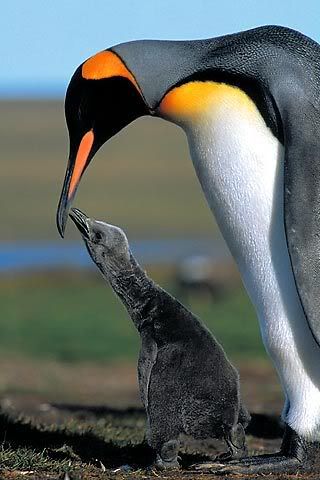
In a long-term investigation on the penguins' main breeding grounds, investigators found that a tiny warming of the Southern Ocean by the El Nino effect caused a massive fall in the birds' ability to survive.
If predictions by UN scientists of ever-higher temperatures in coming decades prove true, the species faces a major risk of being wiped out, they say.
The species is unusual in that it takes a whole year for all the birds to complete their breeding cycle -- the ritual of courtship, egg laying, incubating and chick rearing.
This extreme length, spanning the Antarctic winter and summer, means the birds are vulnerable to downturns in seasonal food resources for incubating their eggs and nurturing their chicks.
Their main diet, small fish and squid, depends on krill. These minute crustaceans are in turn extremely sensitive to temperature rise.
Source: The Times of India
Monday, January 28, 2008
Passing Penguin

The Boulders is an amazing beach south of Simon’s Town where you can hang out with flippered friends in a secluded setting. The penguins stay mostly hidden except for an occasional dash between the boulders or a dip in the water.
(via)
Thursday, January 17, 2008
Studying Penguin Poop in Antarctica
Louise Emmerson has spent the past five years in a Hobart laboratory preoccupied with understanding the lives of Antarctic Adelie penguins. Her task in Antarctica is less appealing, she has come to collect their crap.
With Australian Antarctic Division project leader Simon Jarman and colleague Mike Double, she will spend the next two weeks living in a remote field hut, playing Pictionary by night, and venturing out into the frigid icescape each day to scrape penguin poo from the snow and rocks, photograph it, catalogue it, and deposit it in tubes to be shipped back to a Hobart laboratory. The DNA within the samples will be used to gain new insight into the Adelie's diet, foraging habits and breeding patterns.
That data will provide a window on the health of the Adelie community, and more broadly, a barometer on the Southern Ocean ecosystems on which it relies.
These birds are canaries in the coalmine in climate change terms. Any loss or movement in the krill and plankton and other creatures that nurture the Adelies and the rest of the marine population will rapidly be reflected in these rookeries.
Source: The Age
Monday, December 17, 2007

Monday, December 10, 2007
Huddle for warmth
Trapped in a fierce blizzard whipped up by 100mph winds, 2,000 King Penguins huddle together for warmth on the island of South Georgia near Antarctica.
To survive in one of the most inhospitable environments on earth, the penguins share body heat to conserve energy and protect the youngest birds. They are gathering for their breeding season in January.

Saturday, December 8, 2007
Penguins have lowest blood oxygen levels ever recorded

The research showed that penguins in Antarctica return from long fishing excursions under the sea ice with the lowest blood oxygen levels ever recorded in wild animals.
With such depleted reserves, experts say, other creatures would black out and suffer tissue damage.
The finding suggests that emperors—the largest of all penguin species—may have a hyped-up version of hemoglobin, the blood protein that carries oxygen from the lungs to the body.
Tuesday, December 4, 2007
Antarctic Wonders Lure Cruise Tourists
This cruise season during the Southern Hemisphere summer—roughly November through February—more than 30,000 people are expected to visit the southernmost continent on 50 different ships, according to the International Association of Antarctic Tour Operators, a trade group.

Monday, December 3, 2007
Bush Administration Delays Protection of Penguins
The Center for Biological Diversity filed a formal notice today that it intends to sue the Bush administration for delaying protection of penguins under the Endangered Species Act. In November 2006, the Center filed a petition to list 12 species of penguins as threatened or endangered under the Act the petition triggered a strict deadline that gave the government 12 months to determine whether protection is warranted for the penguins. In July, the Fish and Wildlife Service found that 10 of the species may deserve protection and began status reviews for those penguins, including the well-known emperor and rockhopper penguins. Now the government is ignoring its duty to move forward with protections for those 10 species, which are threatened by global warming.
"There's no time to wait when it comes to global warming," said Kassie Siegel, director of the Center's Climate, Air, and Energy Program. "We won't allow the Bush administration to continue to violate the law while these penguin species march toward extinction."
Wednesday, November 28, 2007
New reserve opened for rare penguin
The world's rarest penguin found only in New Zealand has a new haven thanks to DOC and the Yellow-eyed Penguin Trust.
A wildlife reserve has been opened in South Otago to protect the bird.
The yellow-eyed penguin is so rare that there are fewer than 500 breeding pairs left in the world.
Now, 50 hectares of land along a South Otago coastline has been secured to ensure the birds' future.
Photo Credit

Tuesday, November 27, 2007
Ice Pix

Subscribe to:
Posts (Atom)