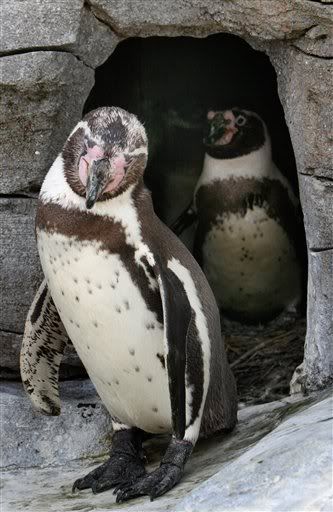
 Two male Humboldt penguins cautiously guard the entrance to their cave in the "Zoo am Meer" zoological park in Bremerhaven, northern Germany, where they are fostering a six weeks old penguin chick.
After a penguin egg had been abandoned by its biological parents, it was placed in the male penguins' nest, who then adopted and hatched it.
Bremerhaven zoo veterinarian Schoene said the male birds, named Z and Vielpunkt, are one of three same-sex pairs among the zoo's 20 Humboldt penguins that have attempted to mate.
AP Photo/Focke Strangmann
Source
(via the Pet Blog)
Showing posts with label birds. Show all posts
Showing posts with label birds. Show all posts
Friday, June 12, 2009
Penguin chick has two dads


Monday, March 2, 2009
Looks like the inauguration, doesn't it?
This amazing photo was taken on South Georgia Island. The photographer says, "This is not the largest colony of king penguins on South Georgia but there were over a hundred thousand breeding pairs in this location. The brown spots are not open spaces but chicks that have not fledged."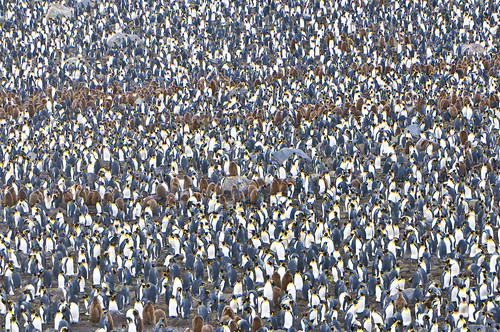 from Flickr, by chuck12600
Take a look at it in the largest size: 3200 x 2135. Better yet, set it as your desktop wallpaper.
(via The Pet Blog)
Monday, February 16, 2009
Friday, February 13, 2009
Thursday, February 12, 2009
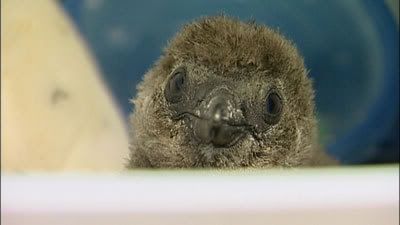
Friday, January 23, 2009
A penguin afraid of water?
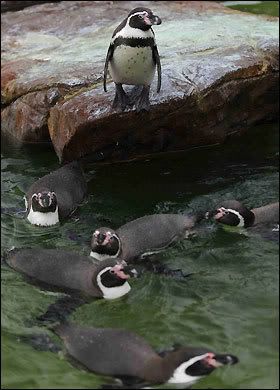 WHILE his feathered friends dive happily through the icy depths, poor Kentucky the penguin perches hopelessly on his favorite rock.
Why? Because he’s afraid of WATER.
He refuses to take the plunge with his other 23 penguin pals at Blackbrook Zoological Park, in Leek, Staffs.
Staff at the zoo have seen 11-year-old Kentucky become a surprise hit with visitors at the park due to his unusual phobia.
Photo: News Team International
Source: Sun
Thursday, January 22, 2009
Underwater
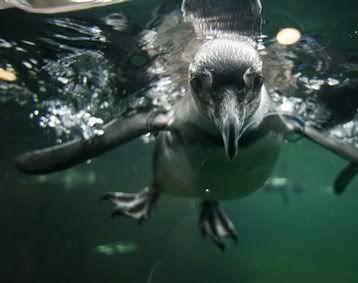 A Humboldt penguin (Spheniscus humboldti) dives in his pool at the zoo in Nuremberg, southern Germany, on December 10, 2008.
AFP/Getty Images
Thursday, January 15, 2009
Meet Pickles
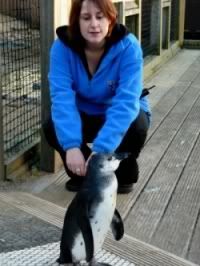 A penguin chick hand-reared by zoo keepers after a family squabble has been named Pickles.
Keepers at Living Coasts in Torquay took in the African penguin chick when it became clear it wasn’t getting as much food as its older sibling. The chick lived the highlife for nearly 4 months, nestling indoors in a cosy den with a cuddly penguin toy for company. It returned to Penguin Beach once it was big enough to take care of itself.
Living Coasts senior head keeper Tony Durkin said: “Pickles has settled back into the colony with no problem at all."
Source
Wednesday, January 14, 2009
Weighing in
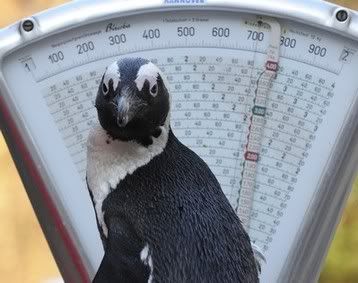 Penguin Sigrid stands on the scales during the annual inventory at the zoo in Hanover, western Germany, on January 12, 2009. During the last weeks, all 1,705 animals living at the zoo were weighed and measured.
AFP/Getty Images
Friday, January 9, 2009
Is there anything cuter?
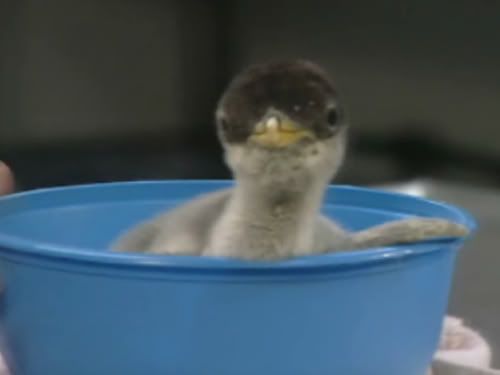 This little cutie was born on Dec. 12 at Moody Gardens in Galveston, Texas.
Monday, January 5, 2009
Successful Penguin-Breeding Season at Sea World
Thirty penguin chicks have been born at SeaWorld in San Diego since mid-November, marking this one of the most successful breeding seasons in the park's history, it was announced.
Among the penguin babies are seven macaroni penguins, six gentoo and 17 Adelies, according to SeaWorld.
Since 1980, more than 500 penguin chicks have been born at SeaWorld.
Source: 10news.com
Friday, January 2, 2009
Happy New Year!
Appropriate for the New Year ...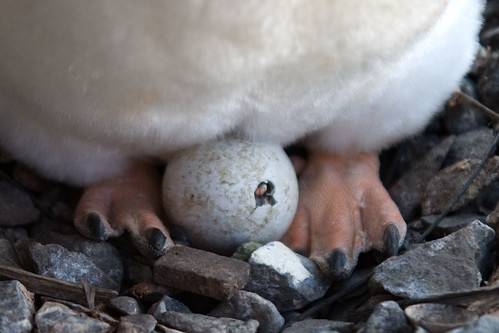 Hatching, originally uploaded by karohemd.
(via Gentoo Penguins at O'Higgins Station, Antarctica)
Friday, December 12, 2008
Wednesday, December 10, 2008
Phillip Island's fairy penguins
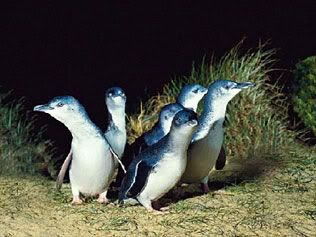 They are as regular as clockwork.
Every night just after sunset, the fairy penguins appear from the cold waters of Bass Strait and waddle up the beach like drunken sailors from a nightspot.
And every morning, at least an hour before the sun considers rising, they are back in the ocean.
It has been like that for many years on Phillip Island, a beautiful part of the world 135km southeast of Melbourne.
they are the lifeblood of the island's economy. Other tourist attractions, restaurants, hotels and everything else, exist because of the public pulling power of the penguins.
The penguins are the No.1 wildlife attraction in Australia. Japanese visitors find them magnetic, and it's easy to see why.
They emerge on Summerland Beach on the Summerland Peninsula like soldiers in little platoons.
They yap, preen and peer, and when all are assembled, they again look like soldiers as, with eyes to the front and wings slightly raised, they advance up the sand and somehow find their home – a burrow full of hungry chicks.
Source: Daily Telegraph
Friday, November 28, 2008
Photographing penguins
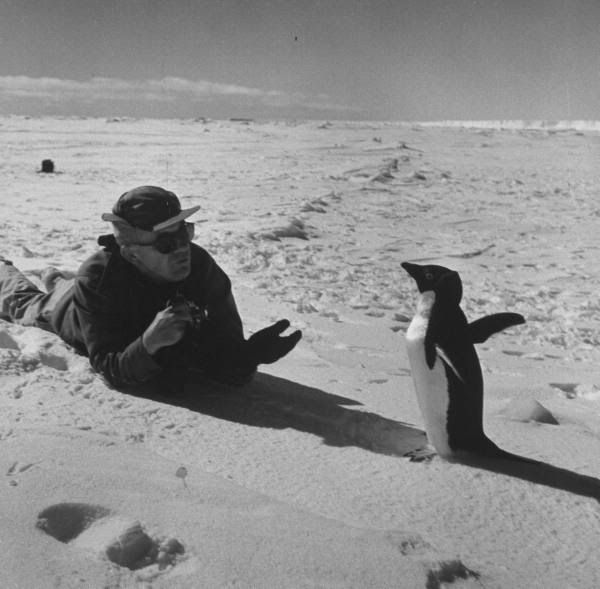 Search millions of photographs from the LIFE photo archive, stretching from the 1750s to today. Only a very small percentage of these images have ever been published. The rest have been sitting in dusty archives in the form of negatives, slides, glass plates, etchings, and prints. Google will be adding the entire LIFE photo archive — about 10 million photos.
This photo:
Ornithologist photographing native penguin.
| Location: | Antarctica |
|---|---|
| Date taken: | February 1956 |
| Photographer: | Fritz Goro |
| Size: | 1280 x 1257 pixels (17.8 x 17.5 inches) |
Thursday, November 20, 2008
We all need friends
 A baby penguin at the Living Coasts attraction in Torquay, Devon, which had to be separated from its family after a greedy sibling continually ate all its food has found companionship with a stuffed toy.
Source: Telegraph
Wednesday, October 8, 2008
One way to get a penguin to fly
A C-130 rolled down the strip with 399 penguins on a one-way trip in Brazil last Friday.
The mission: To save the Magellanic penguins that had been stranded 1,550 miles north of their typical feeding grounds and were starving on the beaches of near Salvador.
IFAW, in cooperation with the Brazilian government, loaded the birds into crates and flew them on a Brazilian air force C-130 to Pelotas, which is on the coast just shy of the border with Argentina.
Once led to the frigid water at Pelotas, the birds waddled away.
Source: AirForce Times
Monday, September 29, 2008
Sleeping penguin
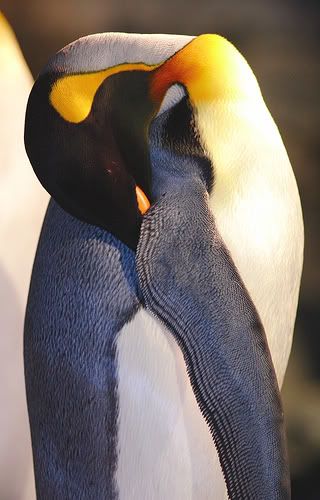 Birds do not put their heads under their wings when they sleep, but instead bury the bill into the scapular feathers.
Penguins are the only birds that properly hide the bill under the wing: they can't submerge any part of their head within their scapular feathers, because their feathers are so short.
If you're interested in the sleeping behavior of other creatures, read "Sleep behaviour and sleep postures" at Tetrapod Zoology.
Photo from Flickr, by jpmatth
Thursday, September 25, 2008
Tuesday, September 23, 2008
Penguins begin their arrival to Argentine coasts
Thousands of Magellanic penguins have begun their yearly arrival to the coasts of the southeastern Argentine province of Chubut, where they will mate and breed for the next few months.
Local media on Friday broadcasted live images of the penguins walking ashore to meet their mates in what they call "The Penguin's Vigil".
And for the first time, this year the local Chubut government have also set up a website which is streaming the penguins' arrival to the Patagonia for 72 consecutive hours.
The migratory sea birds travel thousands of miles every year around this time from the coasts of Brazil to meet their partners and reproduce in the Patagonia's penguin colonies.
As temperatures begin to drop the penguins will then make their way back up the continent in search of warmer waters.
Chubut penguin website (in English)
Chubut daily penguin videos
Subscribe to:
Comments (Atom)