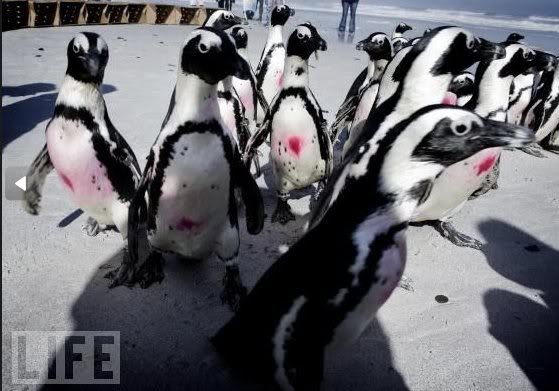
Penguins walk toward the ocean after being released near Cape Town, South Africa. The 38 birds had been treated for oil pollution they'd suffered in Namibia.
Photo: GIANLUIGI GUERCIA/AFP/Getty Images
May 26, 2009
Showing posts with label rescue. Show all posts
Showing posts with label rescue. Show all posts
Thursday, June 11, 2009
I'm getting closer to my home


Wednesday, October 8, 2008
One way to get a penguin to fly
A C-130 rolled down the strip with 399 penguins on a one-way trip in Brazil last Friday.
The mission: To save the Magellanic penguins that had been stranded 1,550 miles north of their typical feeding grounds and were starving on the beaches of near Salvador.
IFAW, in cooperation with the Brazilian government, loaded the birds into crates and flew them on a Brazilian air force C-130 to Pelotas, which is on the coast just shy of the border with Argentina.
Once led to the frigid water at Pelotas, the birds waddled away.
Source: AirForce Times
Monday, August 11, 2008
Penguin rescuers deployed to Brazil
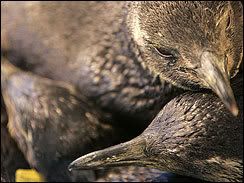 More than 1000 juvenile Magellanic penguins have washed-up either dead or dying along the Brazilian coast and as far north as Natal in Rio Grande do Norte, 3000 km north of Sao Paulo. IFAW (International Fund for Animal Welfare - www.ifaw.org ) deployed a team of penguin rehabilitation experts to assist local animal centers that are handling penguins for the first time.
"This event appears to be a natural occurrence and has been seen 2 or 3 times in the last 20 years, resulting in the death of thousands of birds. What really took us by surprise this time is the huge increase in numbers," said Valeria Ruoppolo of IFAW.
The Magellanic penguins (Spheniscus magellanicus) breed in large colonies in southern Argentina and Chile and migrate north as far as Southwest Brazil between March and September. According to experts, there is a flow of warmer water (1C higher than normal), which has caused the juvenile penguins to keep going north, past their usual range, where they are unable to find adequate food. Almost all of the penguins being found on beaches in northeastern Brazil have been juveniles and since they are starving, they come into care in an extremely debilitated state.
IFAW's experience in rehabilitation has saved the lives of tens of thousands of penguins. In 2000, IFAW helped save an entire species -- rehabilitating and releasing 19,000 African Penguins caught in the Treasure oil spill off South Africa. Today, IFAW's oiled wildlife response team is widely recognized as the world's finest.
Photo credit: Ricardo Moraes / AP
Source: Market Watch
Thursday, July 17, 2008
Fleeting fame for poor Percy
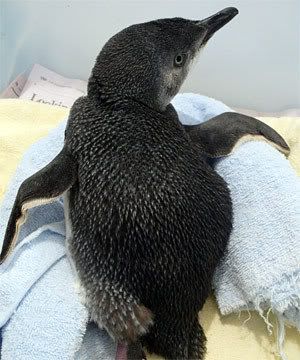 Poor Percy was found washed up near Wellington's Shelly Bay this month. His leg was tangled in a fishing line and broken.
Percy was nursed back to health with fresh salmon, daily massages, and even fixed up with a female.
But unfortunately, Percy died just hours after being picked as the mascot for a penguin rescue project.
The circulation to his foot could not be recovered despite the massaging and had to be amputated. He then lost condition and had to be euthanized.
(via Stuff)
Wednesday, July 9, 2008
Dog bite can't keep this penguin down
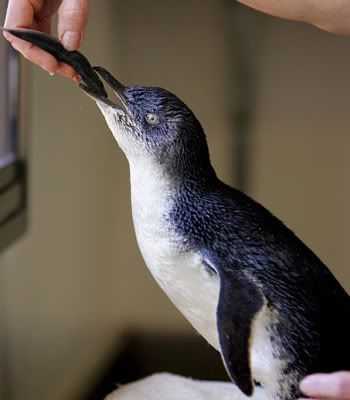 When he was found lying seriously injured on a beach, Collin from Collaroy was in such bad shape there was little hope he would survive.
The small penguin had deep wounds to his left eye, abdomen, groin and leg after being attacked by a dog.
But Collin has since made a remarkable recovery. "He's a little fighter, which is a good thing when you have such substantial injuries," Taronga wildlife hospital's general manager Libby Hall said.
"It would have been very painful. He's now standing up and eating quite well."
Since being admitted into intensive care, Collin's wounds have been cleaned and he has been placed on antibiotics, pain killers and anti-fungal medication.
Source: Daily Telegraph
Monday, June 23, 2008
Ready to go home
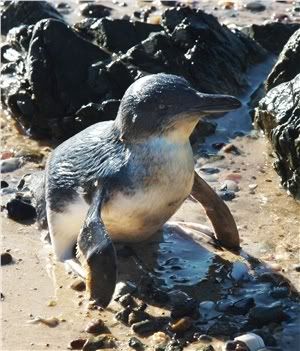 This little penguin nearly died from exhaustion a week ago. She was found washed up on Miners Beach lying flat out on her back.
“She was most likely beaten up by rough seas and storms,” a For Australian Wildlife Needing Aid (FAWNA) volunteer, June Le Pla, said.
Ms. Le Pla nursed the penguin back to health for a week on a diet of pilchards, whitebait and squid.
She said the penguin, whom she named Penelope, was most likely about a year old and could expect to have an average lifespan of about six years in the wild.
On Friday, Penelope was set back into her native habitat at Shelly Beach.
Source: Port Macquarie News
Tuesday, June 10, 2008
Washing and saving penguins
At least one hundred penguins and other sea birds, found along Uruguay's beaches, were affected by the oil spill after two merchant ships collided off the coast of Uruguay. The Greek merchant ship Syros suffered a fuel leak after colliding with the Maltese vessel Sea Bird on June 4.
Over 60 dead oil-covered Magellanic penguins washed up on Uruguay's coast Sunday that environmentalists believe is linked to an oil spill, following a collision between two ships near Montevideo's port a few days ago.
Meanwhile, 34 live oil-covered penguins appeared on the beaches of this South American nation's southern coast, Richard Tesore of the SOS-Marine Life Rescue environmental group said.
Scientists fear the penguin death toll is likely to rise in the coming days. An oil-covered penguin is seen in the backyard of the S.O.S Rescate Fauna Marina (S.O.S Ocean Fauna Rescue), a non-governmental organization devoted to the rescue of ocean fauna, in Piriapolis, about 100 km (62 miles) east of Montevideo.
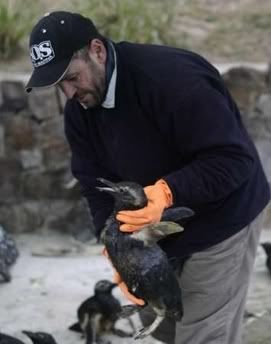 An oil-covered penguin is carried by Richard Tesore, manager of S.O.S Rescate Fauna Marina.
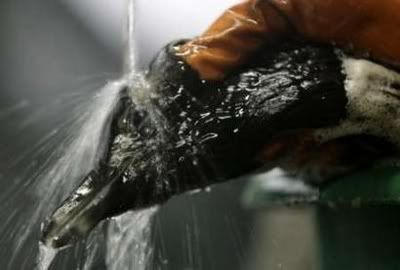 An oil-covered penguin is washed with fresh water and soap to remove the oil.
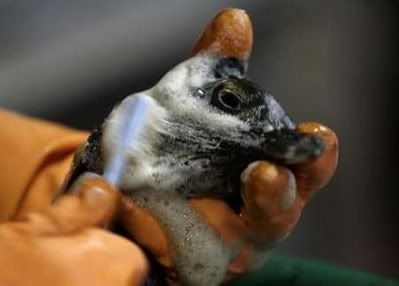 An oil-covered penguin is washed with fresh water and soap to remove the oil.
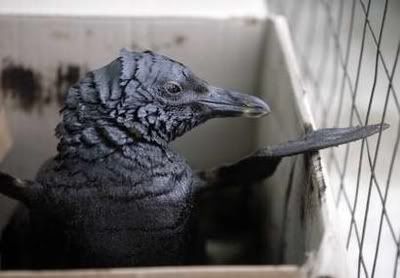 An oil-covered penguin is seen in the backyard of the S.O.S Rescate Fauna Marina.
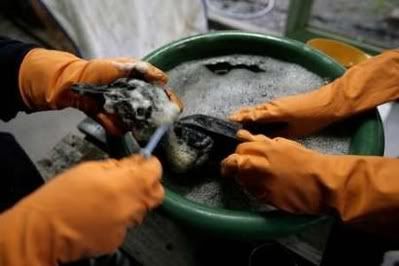 An oil-covered penguin is washed with fresh water and soap to remove the oil.
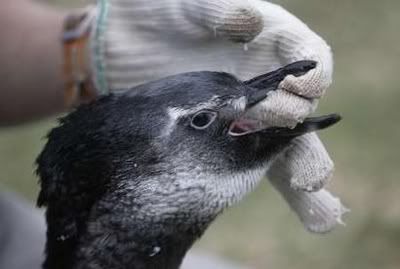 A penguin affected by oil spill is fed and being taken care of by non-government organization S.O.S Rescate de Fauna Marina devoted to the rescue of ocean fauna.
Photos: Reuters
Friday, March 7, 2008
Video: Orphaned Penguins Hand Fed
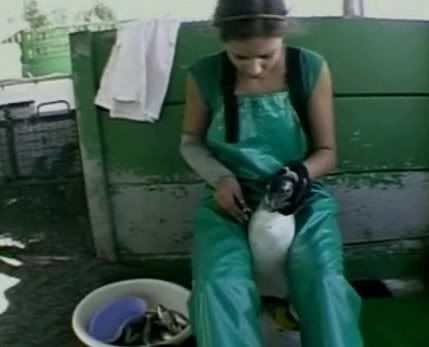
The latest threat to African penguins may be a food shortage. That's probably why many chicks are abandoned, says a group that's rearing 400 orphans.
Watch video
Source: National Geographic
Friday, November 2, 2007

Friday, August 17, 2007
Yellow-eyed penguin nursed back to health
 A young female yellow-eyed penguin has been nursed back to health at the Veterinary Teaching Hospital Wildlife Ward.
The sick penguin was found collapsed at Sumner Beach, Christchurch, last month, emaciated and weak and was flown to Palmerston North by the Department of Conservation.
The penguin, one of an endangered population of about 5000, had diarrhea, a secondary yeast infection, enlarged kidneys and weighed just 3.4kg. The penguin was flown back to Christchurch last week, having fully recovered and gained 1.2kg.
Thursday, August 2, 2007
Hundreds of Oil-Covered Penguins Surface in South America
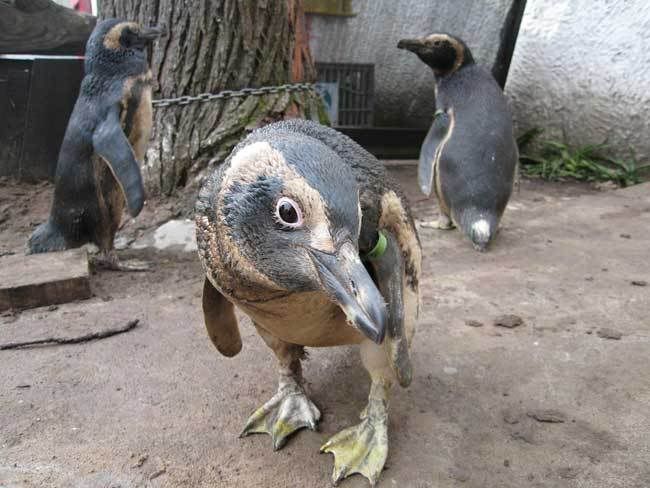 Hundreds of oil-covered Magellanic penguins have surfaced off the Atlantic coast of South America in the past few weeks, according to an animal welfare organization.
This week, 36 Magellanic penguins were being treated at the Society for the Conservation of Biodiversity in Maldonado (SOCOBIOMA) center in Uruguay, where more than 40 of the penguins surfaced.
"After being stabilized and fed, the washing process is in full motion right now, and we expect to be able to release them back to the ocean in about 15 days or so," said Lourdes Casas of SOCOBIOMA.
Monday, May 7, 2007
Penguin can sea clearly now the oil has gone
 It may not be the biggest penguin on the planet but it's one tough customer nonetheless.
This penguin was recovered from Tauranga Harbour about three weeks ago, under weight and covered in oil. It is now recovering at Living Art Wildlife Park in Greerton.
"It took us about a week and a half to get all the oil off him," park operator Mark Paterson said.
The little blue penguin is thought to be three to four months old and is a commonly seen species that nests on the shores around Mauao.
Sunday, May 6, 2007
Unusual guest goes home

A LONELY royal penguin was a long way from home and unable to swim when he was rescued by wildlife carers at Princetown recently.
There are thousands of royal penguins on Macquarie Island, between Tasmania and Antarctica, the only known place the penguins breed, but only three have ever been seen in Victoria.
A TAFE group found the two-year-old penguin in March and it was taken to the Wallaby Creek Wildlife Shelter at Peterborough run by Annie Fraser.
Mrs Fraser cared for the penguin for about a month while he moulted and gained enough weight to make the journey back to Macquarie Island.
Wednesday, April 25, 2007
Kiwi penguin lands on his feet with $63m home
And the male penguin, now known across the Tasman as "Mr Munro" has landed on his feet, being pampered with a couple of sex-starved females, a new architect-designed home, and all the fish he can eat.
Mr Munro washed up on the NSW central coast near Norah Head in November last year. He was quite underweight, had breathing and respiratory problems after a 2000km swim from the South Island.
He has since been pampered back to a healthy 4kg.
"He was wheezing and severely underweight," said Taronga Zoo's penguin keeper Jo Walker. "We've fattened him up on a diet of pilchard, whiting and squid."
And she yesterday introduced Mr Munro to the only other two Fiordland penguins in captivity – two females who have lived without a bloke for 13 years.
"Due to strict importation and quarantine rules for bird species we literally had to wait for a male to wash up on our shoreline," Ms Walker said.
"They're a bit excited," Ms Walker told the Sydney Morning Herald . "Chalky's been grooming herself a lot lately."
Tuesday, April 24, 2007
Female Penguins See Male Penguin for First Time in 13 Years

Wednesday, April 18, 2007
Heartbreak Hotel as king penguin can't leave
Elvis is a king penguin that washed ashore near Cape St Francis in January, many thousands of kilometres away from his home on one of the sub-Antarctic islands.
No one knows how he got here, but when Trudi Malan of the Ajubatus Marine Rehabilitation Centre in St Francis was alerted, she and a local nature conservator rescued the creature.
The fellow is in a rehab centre on a windy headland in Cape St Francis and, every now and then, he throws back his head and croons his rather haunting song.
"I can't believe how well he's looking now. He is beautiful. My wish is to release him back home, possibly to Marion Island, but the scientists say we can't because of the risk that he will carry back diseases.
"I understand that from a scientific point they can't take that risk. But for us, it's a very emotional thing. Kings are very gregarious penguins, they breed shoulder to shoulder and they like to be with their friends," said Malan.
"And every time he calls, ah, I just want to die. He throws it back and makes this sound. It's beautiful but it's so sad."
Tuesday, April 17, 2007
The Penguin Foundation
 The Penguin Foundation was established to protect and preserve one of Australia’s most important natural assets – the Little Penguins.
The Penguin Foundation raises and allocates funds to projects ranging from penguin rescue and rehabilitation in the event of a man-made disaster; to building new penguin nesting areas; monitoring penguin health and behaviour; and protecting the Little Penguins’ natural environment. Resources will also be used to undertake other associated wildlife and conservation activities on and around Phillip Island.
Thursday, March 1, 2007
The Penguin Lady: Local teaches new generation to care about animals
 Georgetown resident Dyan de Napoli will never forget the day she first entered a South African warehouse in 2000 to work as a rehabilitation manager with the first team of penguin experts working to save 20,000 penguins. The flightless birds were covered with oil when the iron ore ship MV Treasure sank near their breeding grounds.
“The smell hit me like a wall and made me gag,’” says de Napoli. “It was this putrid smell of oil, guano, sardines, human sweat, coal dust and food being cooked for volunteers. Before returning home I had to throw away my clothes, shoes and backpack or there would have been a riot on the plane.”
Out of 20,000 oiled birds, 91 percent were successfully rehabilitated and returned to the wild, the largest number of a single species ever to be rescued and rehabilitated. She is writing a book on her experiences during the massive international rescue effort.
Fortunately for the penguins, a 17-year-old student had invented a first-stage degreaser one year before the spill, says de Napoli.
Saturday, February 3, 2007
All Penguins Are Cute, But Some Are More Cute Than Others
It could be their immaculate fashion sense or maybe it's that sweet, wobbly gait, but there's no denying penguins are, well, adorable. Like the rest of their cuddly class—the pandas, koalas, seals and bunnies—they help sell greeting cards and animated movies by tugging at our heartstrings.
But research shows our fondness for particular animals could have detrimental effects on preservation efforts. These so-called "glamour animals" dominate fundraising campaigns and news headlines, siphoning money away from more needy—if less photogenic—creatures, according to some experts.
Now scientists say that even within the cutest populations, we still play favorites.
David Stokes, a conservation biologist at the University of Washington, sorted penguin species by looks into what he called “morpho-species” and found that certain groups were overrepresented in popular photography books, a.k.a. coffee-table books. With greater “photograph area,” these penguins showed up more frequently and in larger pictures—the Paris Hiltons of the avian set.
Thursday, January 25, 2007
Historic visit by sub-Antarctic king takes rescuers by surprise
A KING penguin from the icy sub-Antarctic Islands surprised environmentalists at the weekend when it was found stranded on the beach at Thuyspunt near Cape St Francis.
It is only the third known sighting of the giant penguins on the South African coastline.
The strange visitor was rescued by Trudy Malan, the operations manager of the marine bird rehabilitation centre Ajubatus, and provincial environment department official Hennie de Beer, after a sighting by a member of the public.
Malan said the king penguin was nearly 1m tall. With yellow teardrop-shaped ear patches and a particularly calm demeanour, it was instantly recognisable, she said.
“Only two others have ever been recorded washed ashore in South Africa, at Blaauwberg in Cape Town in 1977 and at the Sundays River mouth in 1982.”
Malan was able to walk up next to the bird and lower a towel over its head, something that would have been impossible with the more aggressive African penguin.
The bird was carried to safety where a marine bird vet examined it and found it apparently unhurt. An antibiotic injection and re-hydrating fluid have been administered and blood samples will be taken to check for any further clues as to why it would have strayed so far from home, and to ensure that it has not picked up any local diseases.
Subscribe to:
Posts (Atom)